You can have a website full of service pages and still miss your future customer’s question. They might want to know, for example, whether they need an aankoopmakelaar (buying agent), when a building inspection makes sense, or what exactly is included in a maintenance contract. Only once that trade-off is clear does choosing a provider come closer.
Those are exactly the kinds of questions that make content interesting. We see that at NieuwHuis Makelaardij, where articles about purchase decisions get clicks from Google. And at Verdam Groep, where we sharpened general explanations with the agreements and boundaries a client needs to know.
A Google patent about generative search answers provides interesting technical background. It describes how information from different documents can come together in a single answer. For us, that mainly raises a practical question: what knowledge does your company have in-house that genuinely helps move such an answer forward?
What the Google patent shows
In Generative summaries for search results, Google describes a system that uses search documents to assemble an answer with a language model. Parts of that answer can refer to documents that support the information.
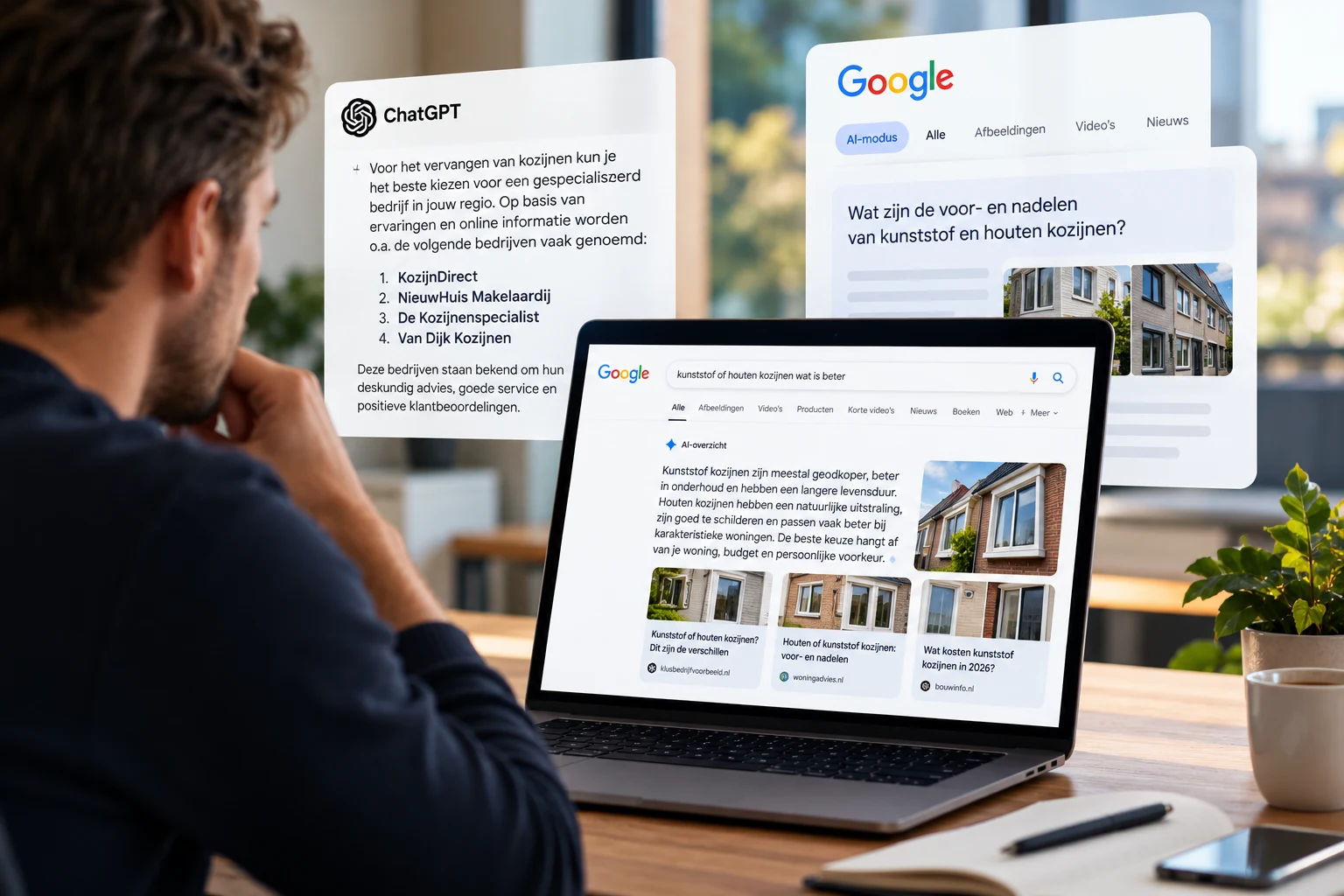
Suppose someone asks which window frames are suitable for an older house. To give a useful answer, several types of information are needed: choice of material, insulation, maintenance, costs, and the options for the existing property. That explanation may be spread across multiple sources.
The patent describes possible ways to select such sources. For example, it mentions relevance to the search query, freshness, and reliability. For reliability, it also mentions the author, the domain, and incoming links.
That does not mean we have found a secret manual for Google. A patent describes what is technically possible, it does not prove which components Google uses today. So it is not a checklist you can use to force a spot in an AI answer.
The current Google documentation on AI Overviews and AI Mode helps connect this to practice. Google explains that these features can run related searches to explore subtopics. This is called query fan-out. A broad customer question can therefore lead to a search for multiple pieces of explanation.
Our editorial translation of that: look at which trade-offs sit behind a question and make sure your website adds something useful to them. What that looks like becomes clearer with a real customer.
Source: Google patent US11769017B1, published upon grant on 26 September 2023, and Google’s documentation about AI features. The patent and the current product explanation are different sources.
NieuwHuis: matching the moment when someone hesitates
Someone who wants to buy a house does not always immediately search for a broker’s name. Other questions may come first. Do I need guidance with the purchase? When do I have a property inspected? And what does that mean for my offer?
On the NieuwHuis Makelaardij website, there are articles that discuss exactly these kinds of choices. The page about when it pays to hire an aankoopmakelaar received 26 clicks from Google. The article about a building inspection around the offer received 17 clicks, both measured from 5 July through 2 October 2026.
What we find interesting there is the connection to the service offering. The articles discuss decisions where a broker’s knowledge is relevant. That gives the reader a substantive reason to continue exploring this website.
That approach differs from collecting topics at random just because there is a lot of search volume. When choosing a topic, we ask ourselves: which decision does this article help someone make, and why is our client the right party to write about it?
For the entire website, we saw 455 Google clicks in the same period, compared with 136 a year earlier, roughly 235% more. The in-depth customer case study of NieuwHuis shows that broader development. We cannot attribute the total growth to these two articles. Nor are these Google figures a measurement of mentions in ChatGPT or Google AI.
Measurement source: Google Search Console, search type web, rechecked on 27 October 2026. Period: 5 July to 2 October 2026; year comparison: the same dates in 2025. The two pages mentioned received 4,515 and 3,089 impressions respectively. Clicks are not unique visitors or enquiries.
The lesson for your own website is simple: look for questions that sit close to a real customer decision. A topic does not need to include your service name to still fit your business well. After that, the quality of the answer is what counts. The next case shows something important about that.
Verdam: the value is often in the details of an assignment
“One point of contact for cleaning and property maintenance” sounds attractive. But that still does not tell a client what they need to agree on. How often will the work be carried out? Which costs are included in the quote? Who gives approval for additional work?
At Verdam Groep, on 25 October 2026 we sharpened an existing article on this topic. The explanation was mainly about convenience and acting quickly. We gave more space to practical agreements: different schedules for cleaning and maintenance, included materials, approval for additional work, and feedback to the client.
One small detail makes it clear why that matters. A cleaner can spot a damp patch. That does not yet mean the cause has been established or that investigation and repair fall under the contract. By explaining that, it becomes clearer what the customer can expect from the collaboration.
That elaboration is included in the article about cleaning and property maintenance with one party. In the explanation about specialist cleaning, we applied the same idea. There, the surface, contamination, and accessibility matter, as do the boundaries of the result. Cleaning, for example, does not restore a damaged coating.
Your own expertise also sits in what you need to assess in advance and what falls outside the assignment. Those are exactly the details that are missing when a text only lists general benefits. For a reader comparing quotes, they can be far more relevant than another paragraph about quality and service.
This case is about a demonstrable content improvement. The original and revised texts have been saved, and the new versions are on the website. An effect on enquiries or AI mentions has not yet been established for this change.
How we translate the patent into content in Klusio
The patent describes how parts of an answer can be linked to supporting sources. We take that idea into our own working method: for an important statement, we want to be able to find what it is based on.
In Klusio, we use available company knowledge, suitable practical examples, and source passages for that. At NieuwHuis, the Google figures substantiate what we say about the pages found. At Verdam, the concrete activities and agreements give substance to the explanation. That way, each source gets a clear function in the story.
Long documents, such as this patent, also need to remain usable. That is why we expanded the processing so that statements can refer back to specific passages and associated conditions. An exception later in a source can determine how you should interpret an earlier statement.
For the entrepreneur, that comes down to content that answers a customer question and shows what the answer is based on. That is our application of the idea behind the patent. We are not replicating Google’s search system, and we cannot guarantee a mention in an AI answer with it.
Give that knowledge a logical place on your website
The next step is deciding where the explanation belongs. Creating a new blog for every follow-up question can actually cause fragmentation. The reader then has to visit multiple pages to understand a single choice.
At NieuwHuis, purchase guidance and a building inspection are topics that can support their own deeper treatment. At Verdam, agreements about scheduling and additional work fit well within the existing article about combined services. The content determines whether you expand a page or need a new one.
That is why we like to start with what is already there. Is an answer missing, a concrete example, or a clear next step? A content gap analysis helps you find that out in a targeted way.
Then connect the explanation to relevant pages. An article about purchase guidance can refer to the service and a suitable customer case study. A project can lead back to the approach. That way, someone can continue reading without having to search again.
The technical foundation also remains necessary. Google says that pages for a supporting link in AI Overviews or AI Mode must be indexed and allowed to appear with a snippet in Search. No separate mandatory AI markup is required for that. So check whether important pages are accessible, the text is readable, and the next step also works on mobile.
Personal experience and clear sources also align with Google’s guidelines for helpful content. Relevant mentions outside your website and honest reviews can help visitors assess your company. Through Authority & mentions you can explore such opportunities. However, a fixed number of links or reviews does not deliver a guaranteed spot in an AI answer.
After an improvement, look at what actually changes
A better article is a step. After that, you want to know whether it is also found and whether it helps the right people move forward.
At NieuwHuis, we can point to Google clicks to specific pages. For the recent Verdam change, we can show which explanation has been improved. Those are different types of evidence, and we treat them that way.
For AI visibility, a different measurement is needed. What question was asked? What answer came back? Was the company only mentioned, or was there also a link to the article? Save that information along with the platform and the measurement moment. That way, you can show a concrete mention instead of relying on a vague impression.
With AI visibility in Klusio you can track such signals. Keep the questions and method sufficiently consistent when comparing measurements. In our explanation of measuring AI search visibility, you can read how to approach that.
More mentions after a change do not, by themselves, prove cause and effect. Search results, competitors, and AI systems change too. By saving your changes and measurements side by side, you can increasingly assess which next step makes sense.
Start with a question your customer really asks
The most interesting part of the patent for us is the idea behind the answer: different sources can each provide part of the explanation. That makes the knowledge in your company worth writing down carefully.
You do not need to rethink your entire website for that. Take one question customers often ask you. Read the page that should answer it. What do you explain in a personal conversation that is still missing there?
That is a good starting point for an improvement. The Growth Engine of Klusio uses available company knowledge and insights to determine such next steps, from sharpening existing content to working out a missing topic. In this video you can see how the components of Klusio come together in that process.
Want to see which questions and improvements apply to your business? Try Klusio free for two days and see your own starting point.