You want to become more visible in ChatGPT and other AI answers. Then it helps to get one thing clear straight away: do you mainly want to be mentioned in AI answers, do you want clicks from Google/AI, or do you mainly want to be found locally in your service area?
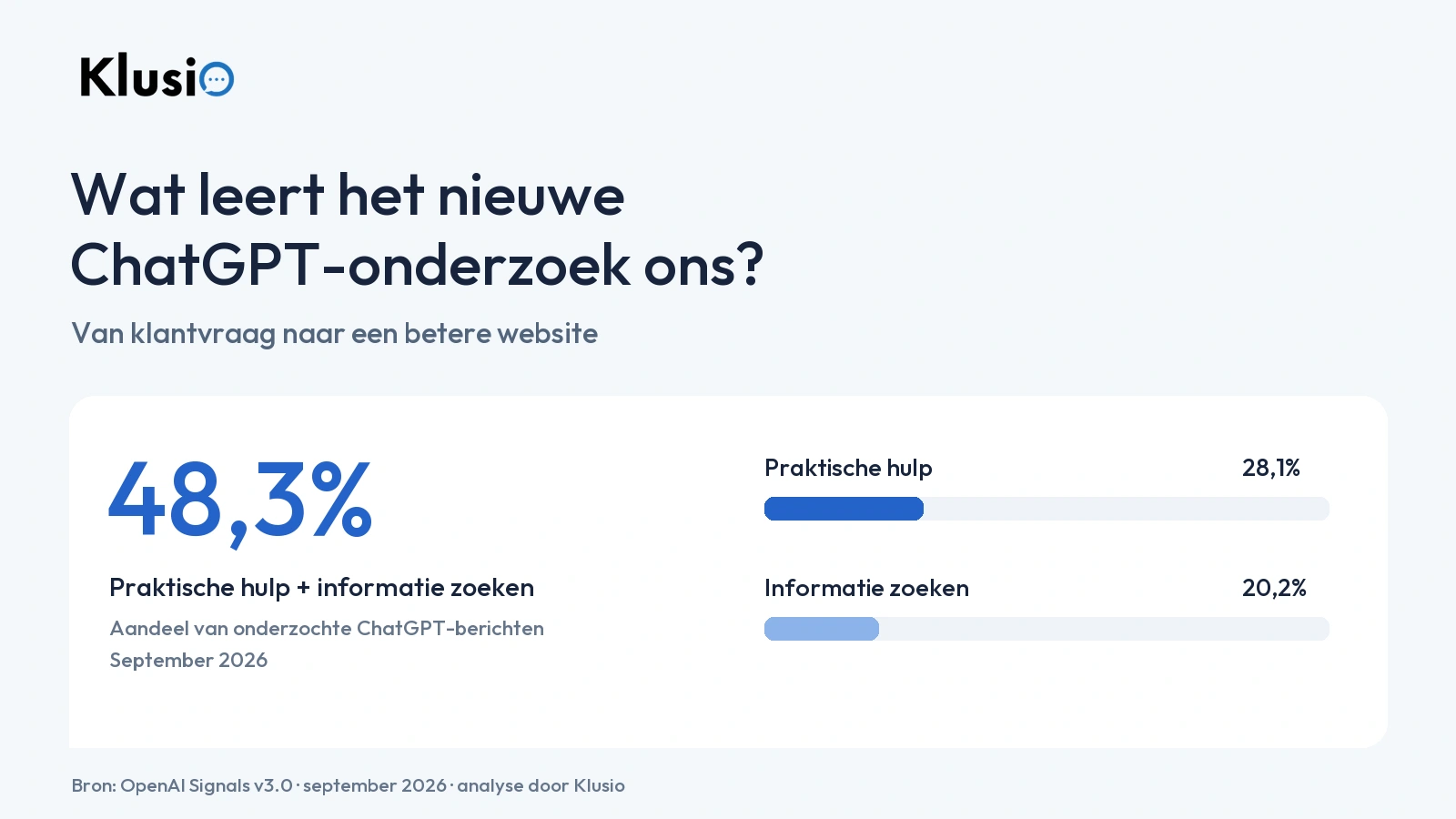
That choice determines which SEO service you use first. There is no universal “AI SEO trick” that works everywhere, and a mention in an AI answer is not a fixed position. In our AI research by Klusio (2026-Q3) (18,206 AI answers, 1 July to 30 September 2026), for example, we saw that a mentioned company, for the same question in the same AI system, was mentioned again in 68% of cases at the next measurement. Useful, but not stable enough to base all your growth on.
Start with your goal: getting mentioned, getting clicks, or growing locally
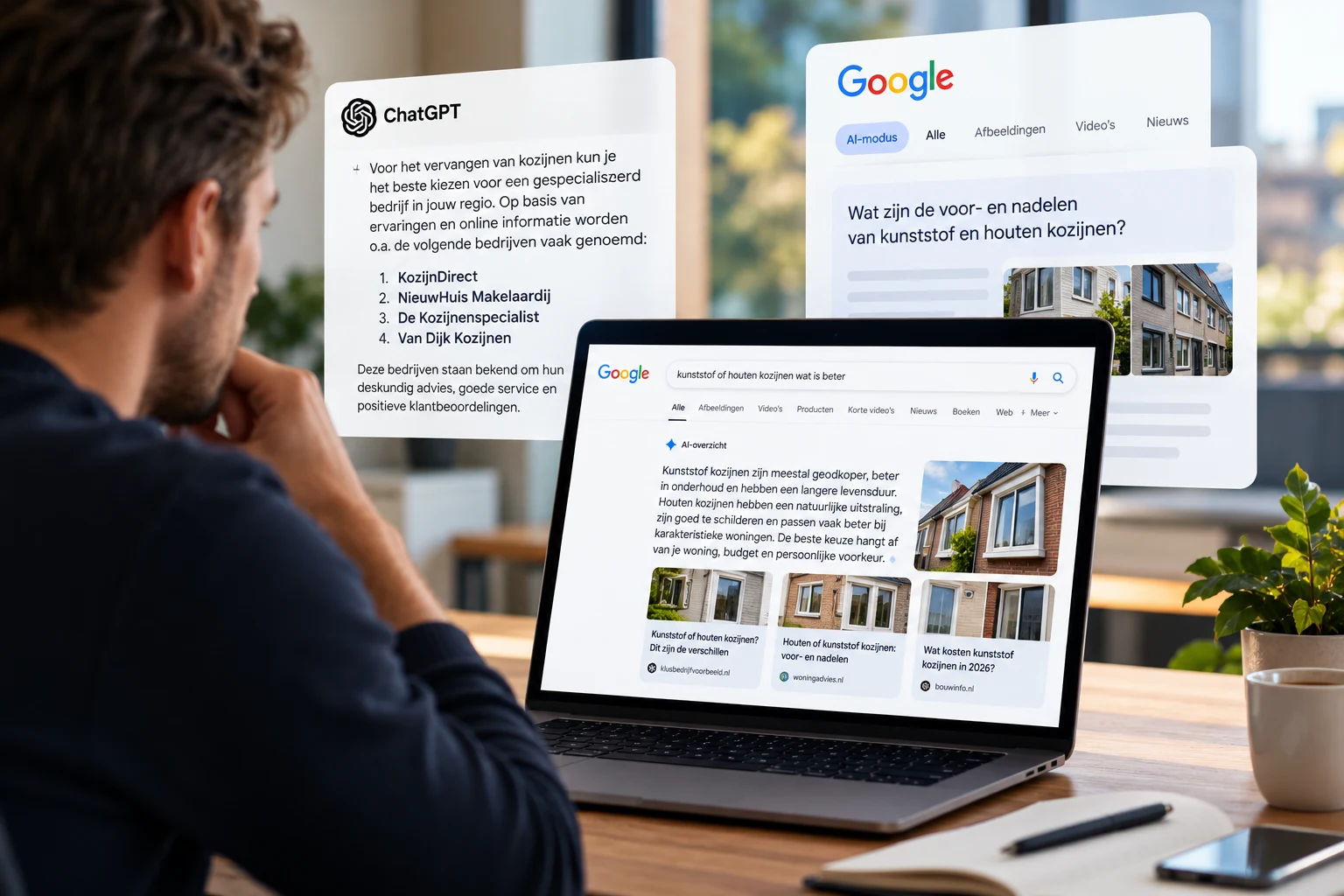
Many entrepreneurs start with: “I want to be mentioned by ChatGPT.” Makes sense. Only: AI systems give different answers to the same question, on the same day, and often use different sources. In that same research we saw that a second AI system mentioned the company being tracked for the same question and day in only 20% of cases as well.
Choose one primary KPI (what you steer on) and one secondary KPI (what you use to check). For example:
- Primary: growth in impressions/clicks in Google (measurable) · secondary: being mentioned more often in AI answers (track per question).
- Primary: being mentioned locally for “service + place” · secondary: organic clicks to local service pages.
- If your site is technically shaky, “AI visibility” is often secondary: you are already missing out on Google opportunities first.
- Technical SEO is usually your first step with a new site, a migration, or when pages are not being indexed.
- service pages that make your work concrete (what do you do, for whom, where, when you do it and when you don’t);
- articles that answer real client questions, including your own proof, steps, and trade-offs;
- internal links that map the route from question → service → proof (case/example) → contact.
- logically incorporating your service area and place names into your pages (without vague “nearby” wording);
- getting your Google Business Profile in order (accurate info, updates, reviews);
- local substantiation: projects, photos, reviews, and recognisable terms from your region.
- setting up a review flow (after completed assignments), and following up on reviews;
- keeping your business listings and profiles consistent;
- building authority with relevant publications and visibility that remains verifiable.
- Pages not indexed / site technically unstable? Start with technical SEO.
- You do have pages, but your story is generic? Start with content (service pages + articles) and internal links.
- Do you sell by region/place? Start with local SEO (service area + Business Profile + projects, photos, and reviews).
- Do you get “who is the best…” questions in your market? Start with authority & reviews, alongside content.
- What is the goal? Getting mentioned, getting clicks, or growing locally, and how do we measure that?
- Which pages go live? No report-only; which improvements are actually published?
- Which source do we use for measurement? For example Google Search Console (impressions/clicks) and a fixed set of AI questions.
- How do we safeguard first-hand expertise? What input do you need to provide so it does not become run-of-the-mill text?
- What do we do about authority outside the site? Reviews, profiles, listings: what is the approach?
- How often do we decide again? SEO and GEO are an ongoing process: opportunities → work that goes live → measurement → next round.
- Technical (developers.google.com)
- AI features (developers.google.com)
- Creating helpful content (developers.google.com)
The 4 SEO service groups that make the biggest difference for AI visibility
When you say “visible in AI”, in practice you mean a combination of: (1) your website can be found and understood, (2) your pages answer real questions, (3) your business is accurate locally, and (4) your authority can be verified outside your own site. These are the four service groups that go with that.
1) Technical SEO: making sure you are even allowed to take part
This is the base layer. If your pages are not indexable, you cannot expect them in Google results, and therefore not as a supporting link in Google’s AI features either. Google mentions as minimum technical requirements, among other things, that Googlebot is not blocked, the page returns an HTTP 200 status, and there is indexable content on it: minimum technical requirements for indexing1.
And for visibility as a supporting link in Google’s AI features, the rule is: a page must be indexed and be snippet-eligible in Google Search: requirements for supporting links2.
What you can practically do with this as an entrepreneur:
2) Content & Writing Studio: win questions with your own expertise (no generic text)
Google’s ranking systems are designed to prioritize helpful, reliable, people-first content, and as a people-first signal the page mentions that content shows first-hand expertise and depth (as an example question/self-check): first-hand expertise and depth3.
That is exactly where a lot of AI content goes wrong: there is text, but there is nothing in it that only your business can say. For AI, and Google, that is the difference between “just another page” and “a page that really adds something”.
What you should be thinking about in your content service:
If you want to organise this tightly with your team or with an external writer, it helps to make arrangements in advance about input, evidence, and editing. We have a separate article for that: agreements for SEO texts.
3) Local SEO: place names are not a detail
For many small and medium-sized businesses, “AI visibility” is really a local question: “which company in region X should I call?” In our research (2026-Q3), having a place or region in the question went together with being mentioned more often: 9.7% versus 2.9% without a place/region (within the same company and AI system 5.1× as often, margin 3.15-11.18). That is a correlation, not a guarantee, but it is a clear direction.
In concrete terms, this means local SEO services often belong on the schedule sooner than yet another generic blog:
4) Authority & reviews: making sure others confirm you too
AI systems pull information from multiple places. In our research we saw that ChatGPT itself searched for reviews or experiences in 9.2% of answers with visible search queries (22% for questions asking for a recommendation). That does not mean “more reviews” automatically leads to a mention, but it does make it clear why authority outside your own site is a serious part of GEO optimisation.
In practice, this is about services such as:
What you can and cannot expect from ‘SEO for AI’
There is a lot of talk about “optimising for AI Overviews” or “becoming discoverable in AI Mode”. The sober point is: Google’s AI features are basically subject to the same SEO guidelines, and there are no extra requirements or special optimisations needed to be able to appear: no additional requirements for AI features2. So you will not win with one new trick, but with a better foundation and better pages.
Which service do you choose first? A quick guide
If you want one sequence without pretending it is the same for everyone, use this guide:
And if you are unsure: start by measuring in the places where you do have control (Google Search Console and your own domain) and use AI measurements as a second track. We have a separate explanation for that, so you do not compare apples to oranges every month: measure AI search visibility every month.
A concrete example from our work (local + content + measurement)
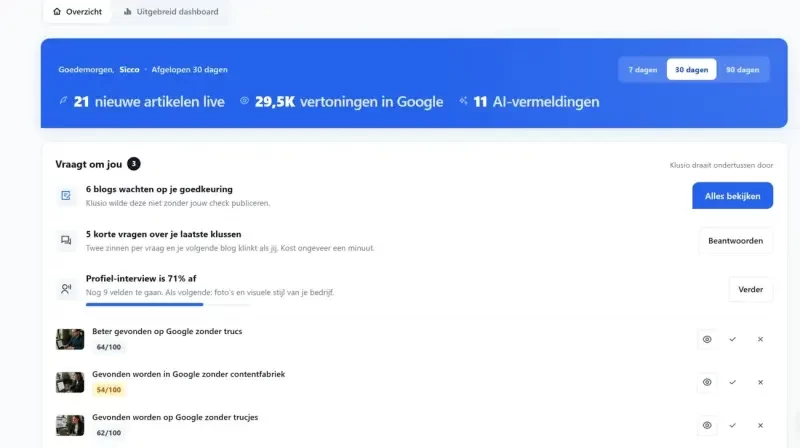
In the case of Hagman Timmer & Onderhoudsbedrijf, the assignment was: become discoverable as a reliable contractor in Delft and the surrounding area, and become less dependent on external platforms. We chose SEO-optimised website development and created targeted content to become discoverable locally and create a citation source for AI systems. The case includes results as measured in Google Search Console and the Klusio dashboard (for example, impressions from 3,948 to 18,355 in 90 days, and 12 AI mentions tracked).
If you want to outsource this: 6 questions to ask your SEO partner
Whether you talk to us or to someone else: these are the checks I would want to hear myself before you spend money on ‘AI SEO’.
Do you want us to take a look at which service group should come first for your goal? Then this is the fastest route: start with a short check of your website, your service area, and your current visibility in Google and AI.