Your future client might visit your website with a very specific question. Do I need a payroll administrator for my first employee? When do I bring in a buying agent? What do I need to agree on before I hire a recruitment agency? These are questions you probably answer regularly during an introductory meeting. Increasingly relevant is whether that same explanation can also be found online.
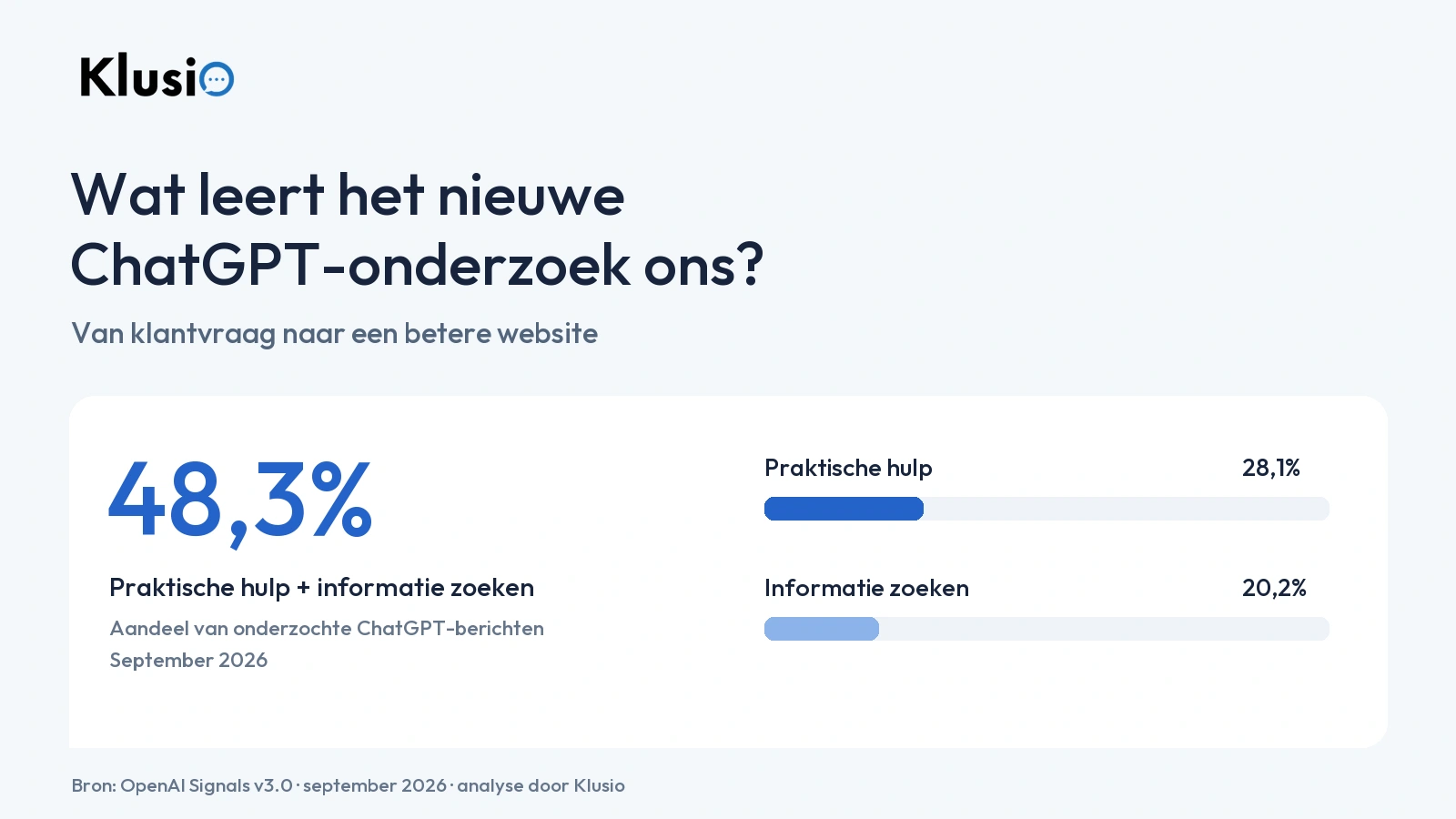
The new research update from OpenAI offers an interesting perspective on this. In September 2026, 48.3% of the analyzed ChatGPT messages were about practical help or searching for information. That share comes from the public Signals data and covers much more than commercial search queries. Still, it is a useful signal for entrepreneurs: also look at your website as a place where someone is trying to understand their situation and prepare a next step.
For Klusio, this aligns with an important choice in our way of working. We look at the questions behind a service, the knowledge a company has about them, and the improvement that makes the most sense at that moment. In this article we explain what the research actually shows and how you translate those insights to your own website.
Which research did OpenAI publish?
On October 26, 2026, OpenAI published ChatGPT’s expanding world of work. This update builds on the How People Use ChatGPT research from September 2025 and the related Signals program.
The announcement focuses on work: the new data describe 165 types of work in almost 100 countries, from the first quarter of 2025 through the third quarter of 2026. In addition, the broader Signals dataset includes data on general conversation topics, including writing, searching for information and practical help. Those monthly data run from July 2024 through September 2026.
That distinction is important. The percentages about searching for information relate to the analyzed messages in individual ChatGPT accounts. So they also cover use outside work. Enterprise accounts and Codex are not included in this dataset.
For this article, we checked the public CSV files. Below are the shares from July 2024 and September 2026, shown as percentages of the analyzed messages.
| Conversation topic | July 2024 | September 2026 |
|---|---|---|
| Practical help | 26,1% | 28,1% |
| Searching for information | 16,7% | 20,2% |
| Writing | 34,1% | 21,4% |
| Technical help | 13,5% | 4,6% |
Source: OpenAI Signals v3.0, file share_of_messages_by_topic_month.csv, accessed on 28 October 2026. This is a selection of the categories, so the rows shown do not add up to 100%. The percentages are shares of messages, not numbers of users or Google searches.
Seeking practical help and seeking information together come to 48.3% in September 2026, compared with 42.8% in July 2024. The difference is 5.5 percentage points, calculated from the same source data. The practical help category also includes, for example, tutoring and personal advice. Seeking information includes, among other things, general facts, products, and recipes. So you cannot read this percentage as the share of people using ChatGPT to find a company.
Even a declining share requires care. Writing takes up less space within this breakdown. That does not automatically mean the absolute number of writing requests has fallen. For that you also need the total number of messages. The same applies to technical help. This dataset does not show whether such questions have moved to Claude or another platform.
Your client first wants a grip on their situation
Our most important takeaway for marketing starts with the conversation with the client. Someone who is still unsure about a purchase usually needs more than a list of providers. First, they want to understand what is sensible, which differences matter, and which risks they need to weigh.
Take as an example an entrepreneur hiring staff for the first time. A page titled “Payroll administration” can offer exactly the right service. Yet questions remain. What information do they need to provide? What does the accounting firm take care of? When should they start? And which activities fall outside the monthly fee?
You see the same need with a homebuyer who is unsure about purchase guidance, or with an employer who wants to outsource recruitment. The service is the offer. The client question is the starting point for the explanation.
The OpenAI research does not prove that these people all use ChatGPT, or that their choice is determined by AI. It does show that practical help and information form a substantial part of the studied usage. For us, that is a good reason to take a hard look at the answers a website provides, both for visitors coming from Google and for people orienting themselves via AI.
A strong services page helps someone decide
Many business websites say who the company is and which services it provides. The next step is explaining when that service is a good fit. That often contains knowledge the entrepreneur considers self-evident, while a new client still has to build it up.
At an estate agent, that might be about the moment when purchase guidance makes sense. At a recruitment agency, about how responsibilities are divided during the selection process. At an installation company, about the conditions that determine whether a particular solution is suitable.
A useful services page brings those considerations together. You describe who the service is for, what the process looks like, what information is needed in advance, and what someone may and may not expect from the assignment. When it comes to costs, you explain which factors determine the price. A number only has meaning when it is clear what comes with it.
That helps the visitor recognise their own situation. It also prevents your site from telling the same general story everywhere about quality, commitment, and customisation. Those words only gain substance when you show how you work.
Read your most important services page as if you are buying the service for the first time. Which questions would you still need to ask before you would dare to make an appointment? That missing explanation is a concrete starting point for improvement.
How Klusio responds to this: choosing topics based on client questions
This idea affects more parts of Klusio than just AI Market Intelligence. It starts with what you choose to write about.
A keyword with high volume is not, by itself, enough reason to create an article. The topic must fit your services, the clients you want to help, and the knowledge your company can add. A broad explainer page can appeal to many people and at the same time connect poorly to the assignments you want to receive.
That is why in Klusio we use available business context and client questions when choosing topics. We also look at what is already on the website. The question is always: which explanation is still missing, for which client is it relevant, and which next step does that explanation support?
For an accounting firm that wants to help employers, a question about preparing for a first employee may be more logical than a general article about entrepreneurship. For an estate agent, the trade-off around purchase guidance may be closer to the service than a broad overview of housing trends. These are illustrative examples of the choice, not measured client results.
The most important step for you as an entrepreneur is therefore to make your focus clear. Which services do you want to grow? For which clients and in which area? The better that context fits, the more precisely Klusio can select topics and improvements.
Your own professional expertise makes the answer useful
A good topic choice is the start. Next, the answer has to add something. That is exactly where the knowledge from your day-to-day work is valuable.
Think of the question you ask in almost every quote discussion, the wrong expectation you want to remove in advance, or the circumstance that leads you to recommend a different approach. Such details make the difference between general explanation and an answer that helps someone assess their own situation.
Through the company knowledge and service knowledge in Klusio, you can capture that information. For example, describe what you want to know in advance, which conditions apply, and when you refer a project elsewhere. Use a practical example only if the facts are correct and you are allowed to share it. A concrete answer does not have to be sales talk; a clear boundary on your service can actually be very helpful.
Instead of “we provide personal guidance”, you can explain who the point of contact is, at which moments consultation takes place, and which decisions remain with the client. That information gives a writer much more to hold on to and gives the reader a clearer picture of the collaboration.
Our application of the research is therefore practical: move the answers from your client conversations onto your website. The quality of those answers remains something you need to assess at the content level. An AI system cannot reliably fill in missing business facts for you.
The Growth Engine chooses where the improvement belongs
When you discover an unanswered question, a new blog article is one possible outcome. Sometimes the explanation fits better on an existing services page. Sometimes an article is missing an important example. And sometimes a technical error comes first, because visitors cannot use the page well.
The Klusio Growth Engine is intended to bring those choices together. Available business knowledge, existing pages, and measurement data help determine which next step makes sense. You decide the focus and what Klusio may execute independently.
Suppose a recruitment agency already has an extensive page about recruitment and selection. If responsibilities during an assignment are missing there, adding them makes sense. A separate article can fit a standalone consideration, such as when a company temporarily needs extra capacity for recruitment. After that, those pages need to refer to each other logically.
This way, each component gets a function. The services page helps assess the offer. A deep-dive article explores a specific question. A practical example makes the working method concrete. Together they form a website on which someone can prepare their choice.
This is also why we see improvement more broadly than publication volume. A carefully expanded page can be the right step. The rhythm and available possibilities depend on your plan, settings, and connected data.
With AMI you track whether your company appears in relevant answers
Improving content and measuring visibility are separate activities. OpenAI’s research shows what people use ChatGPT for. It does not tell you for which questions your company is mentioned. For that, you need your own measurements.
With AI visibility in Klusio you track selected questions that fit your company. It is also useful to include questions without your own brand name. “What does my company do?” gives a different picture than a question from someone who is still looking for a suitable approach or provider.
Then look beyond a single percentage. For which question did your company appear? On which platform? Was only the name mentioned, or was a page also referenced? Which other companies and sources were in the answer? A saved answer with the measurement moment makes such a result verifiable.
The next step here does not have to be a new article either. Perhaps your site lacks an explanation of a relevant trade-off. Perhaps a business detail is unclear. Or the question turns out to be so broad that the outcome says little about your target audience. The measurement helps you investigate where attention is needed.
For a usable comparison, the tracked questions and measurement method must remain sufficiently consistent. In our article about measuring AI search visibility we work this out further. More mentions are a visible result, but on their own they are not proof of more enquiries or of the effect of one change.
Google, AI, and enquiries should be viewed side by side
Ultimately, an entrepreneur wants to know whether the right people are finding their company and whether that leads to appropriate conversations. That is why we keep different results separate.
Google impressions and clicks say something about your presence in search results. AI measurements show what happens for the tracked questions. Website visits and recorded enquiries add yet another layer, insofar as the required measurements have been set up.
You can place that data alongside the improvements you have made. Does an updated page get relevant clicks? Does your company appear for a tracked client question? Do you receive enquiries that fit the service you are focusing on? That helps substantiate the next choice, without attributing every change immediately to a single article.
So the Signals research is not a reason to let go of Google. It is a reason to investigate the information need behind your keywords and AI questions more seriously. A clear answer on your website also has value for someone who arrives directly or receives your link after a personal conversation.
What can you do with these insights today?
Choose a service that is important to your company and pull up the corresponding page. Then write down the questions clients ask before they agree. Think about suitability, cost breakdown, preparation, lead time, and the boundaries of the assignment.
Compare those questions with the text that is there now. Add missing answers using your own way of working and check whether examples and conditions are still up to date. Then decide whether a follow-up question deserves its own article or fits better within the existing page.
If you use Klusio, record this knowledge in your company and service knowledge and check your focus in the Growth Engine. In your AI measurements, check whether the tracked questions align with the choices your clients actually make. This connects content, execution, and measurement to the same service.
The most useful question after this research is: what does my client need to understand before they can choose us? Whoever answers that carefully builds a website that does more than present an offer. You make your company’s knowledge accessible at the moment someone needs it.
Want to see how Klusio brings these components together? See how Klusio works and discover how you can work on your visibility based on your own services and client questions.
Sources and notes
This article is an analysis by Klusio, produced with AI support on 28 October 2026. The research data was checked in the public OpenAI Signals download. The examples are illustrative. The applications for websites and Klusio are our own interpretation; the research does not test or assess Klusio.
- OpenAI: ChatGPT’s expanding world of work, research update of 26 October 2026.
- OpenAI Signals: data and interactive charts, with general usage data up to and including September 2026.
- OpenAI Signals v3.0: download and methodology. For the table and totals we used share_of_messages_by_topic_month.csv. Percentages were calculated by multiplying the published shares by 100. Rights holder: OpenAI, 2026, used under CC BY 4.0.
- How People Use ChatGPT, original research from 2025 (PDF), as background. The figures in this article come from the 2026 Signals update.
The dataset concerns individual ChatGPT subscriptions and includes no Enterprise or Codex usage. Messages are automatically classified, and the published data has been edited for privacy protection. The outcomes describe the studied usage; they are not a prediction of your traffic, AI mentions, or revenue.