GEO optimisation
GEO: improve the information behind AI answers.
Generative engine optimisation (GEO) means improving content and business information for use in AI-generated answers. Klusio helps you inspect recorded answers, identify missing or outdated information and prepare specific page changes. AI platforms decide whether to mention or cite your business.
An absent mention needs investigation
Your service may be listed while the audience, conditions or project evidence remain unclear. The tested question may also be a poor fit for your business. Those situations need different responses.
Begin with a relevant question and a saved answer. Compare it with your website and the evidence you can supply. That creates a concrete content task instead of an unsupported promise to improve an AI ranking.
Choice: Google figures and a separately recorded AI answer
Choice Kozijnen’s case records +65% Google impressions and 316 clicks in its first 90-day comparison, described as April to July 2026. Clicks increased +56% compared with the preceding 90 days. A separate saved ChatGPT answer names Choice first for a window-replacement question in Lisse. Its exact measurement date and a paired baseline are not visible in the screenshot.
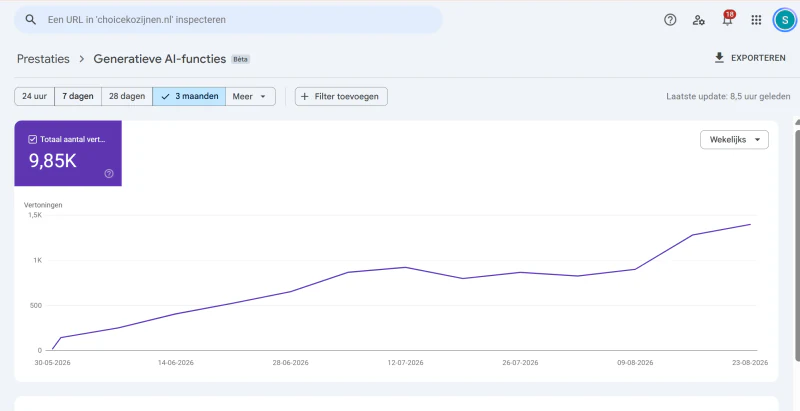
The Search Console generative-AI report below records 9,850 impressions in a three-month report exported on 1 September 2026. It is a separate window from the first Google comparison. Neither the screenshot nor these totals proves which individual page change caused an AI mention.

Connect the observation to specific website work
GEO becomes practical when a measurement leads to a clear question about your content. Preserve the original observation so that later comparisons remain meaningful.
- 1. Choose a question your company fits
- A provider question with a service and place is easier to assess than an unrelated broad topic. Check which companies and sources appear in the saved answer.
- 2. Find what your page actually lacks
- Is the working area clear? Is there a relevant project? Can you substantiate experience or warranty claims? Use your business context to expand the existing page or answer a genuinely missing question.
- 3. Measure the same questions afterwards
- Record the changed URL, publication date, platform and question. Compare later mentions, descriptions and source links. One answer can differ from the next and is not a full effect measurement.
Inspect the answer and its visible sources
Open the tracked question to inspect the answer, named companies and available source links. Use those observations to investigate which information on your own website needs attention.
Watch the original product recording Dutch interface · optional
What to check when an assistant names a competitor
Open the actual answer before deciding what to change. A missing mention alone does not tell you which page needs editing.
- Does your business fit the request?
- Check service, place, audience and conditions. A supplier for business projects may not be a suitable recommendation for a consumer request.
- Can someone assess your offer?
- Explain what you do, for whom, where and how. Relevant projects and experiences can help a customer compare providers.
- Is the description accurate?
- Inspect the visible sources. Correct outdated information on your own site. For an external source, identify its owner and arrange any change separately.
Measure the change without overstating its cause
An appropriate recommendation may bring your offer to someone’s attention. Its value depends on the match between the question, your service and how the business is described.
Record the same questions and compare subsequent answers. A source link shows where an answer points; it does not prove that one source determined the recommendation. You can check the work performed and the observations, while the cause of a change may remain uncertain.
Use evidence from your own business
Project photos, genuine customer statements, staff experience, working area and clear service conditions make an explanation specific. Klusio can structure and apply this information. An unsupported claim should not be presented as proof.
GEO optimisation suits ongoing work on the information behind AI mentions. If you first want to establish who appears, begin with visibility measurement. Technical accessibility remains a prerequisite, and the AI platform controls its answer.
Without this taking us much extra time, the platform gives us a professional online presence and we are noticeably receiving more enquiries through the internet.
Try the workflow with your own website
The free start gives 48 hours of access without payment details. When you choose execution, it includes up to 1 trial article. Publication needs a supported connection and your permission. This period lets you assess the workflow; organic growth needs a longer, comparable measurement window.
Plans differ in work rhythm, features and guidance. A useful improvement can be a new article, an update to an existing page or a corrected issue. The rhythm is not a quota of new articles. The free-start introduction is in English; articles and Dutch-market search queries stay in Dutch. You can also discuss the fit in an English demo.
Questions and answers
What does GEO mean?
GEO stands for generative engine optimisation. It concerns content, company information and evidence that AI search systems can use in their answers. Klusio uses recorded answers to inform that work. Inclusion in an answer or a source citation is not guaranteed.
How does GEO differ from measuring AI visibility?
Measurement records what appears for tracked questions. GEO uses those observations to inform improvements to the website and supporting evidence. An observation is input for work, not completed execution.
Is a ChatGPT position guaranteed?
No. AI platforms determine their own answers. You can check the completed work and subsequent measurements, but Klusio cannot guarantee a fixed mention or position.
Do I need a separate page for every AI platform?
Usually one useful page per customer question or service is enough. A platform-specific page needs its own genuine information purpose.
Can GEO be useful for a local business?
Accurate services, a real working area and relevant projects can clarify a local business profile. Resulting mentions must be measured for each question, place and platform.
Let’s look at your website.
Tell us what you want to improve. We’ll show you how Klusio could help, in English.